
Earthquakes in Costa Rica
Earthquakes in Costa Rica
This month, we experienced a pretty strong earthquake, followed by several noticeable aftershocks in the days that followed. I grew up in California, where earthquakes were simply part of life. However, for someone experiencing an earthquake for the first time, it can be quite rattling.
I was recently stopped by someone who told me, “You’ve done videos about whales, macaws, surfing, sunsets, and restaurants, but you never warned us about earthquakes.” So, here is your official warning.
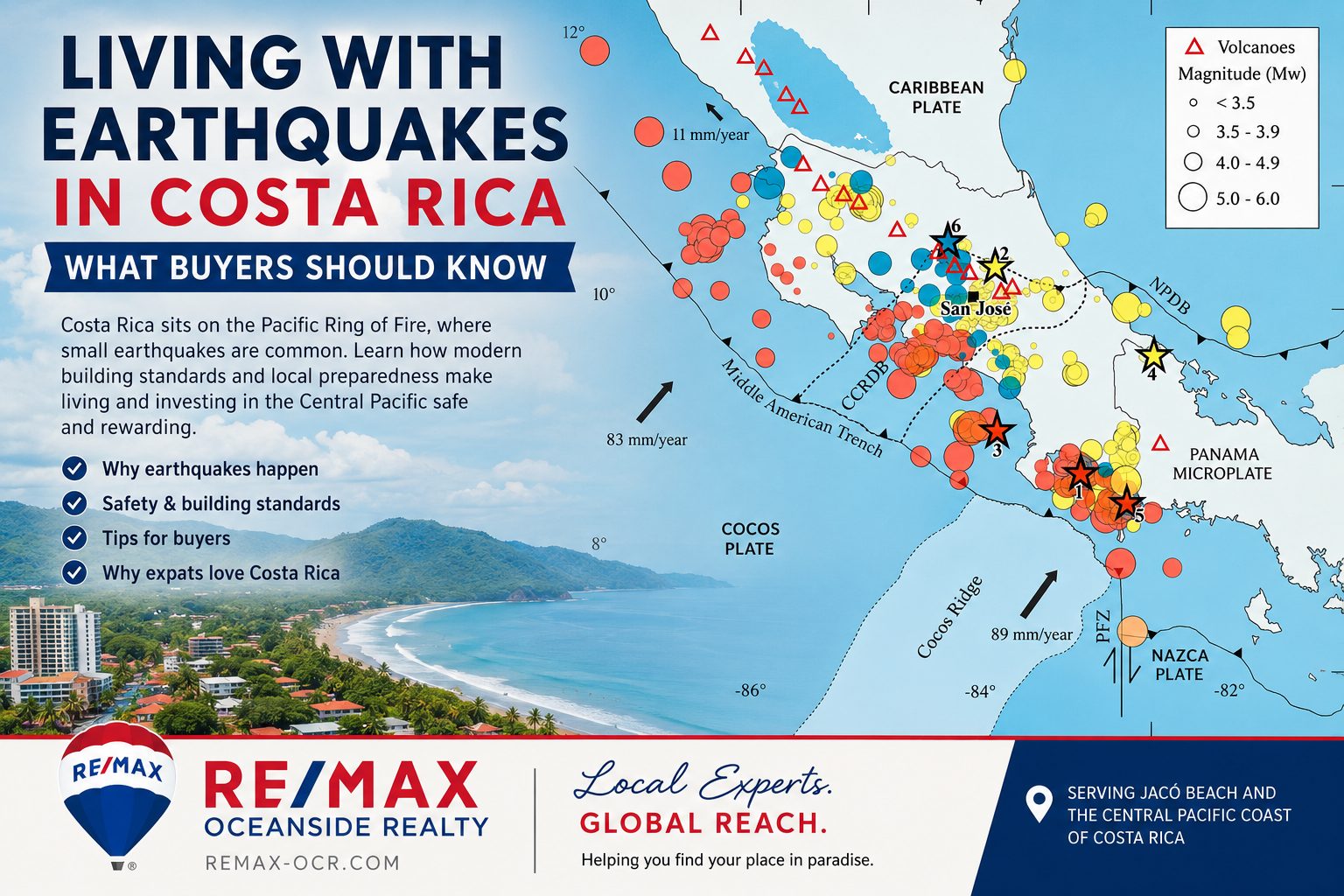
Costa Rica lies on the Ring of Fire, a massive horseshoe-shaped zone around the edges of the Pacific Ocean where many of the world’s earthquakes and volcanoes occur. It stretches along the coast of South and Central America, continues up through California and Alaska, and reaches across toward Japan.
Fortunately, it is not an actual ring of flames, because that would make beachfront marketing a little more complicated.
The Ring of Fire is an area where tectonic plates converge, which is why Costa Rica experiences frequent small earthquakes, occasional stronger earthquakes, and has a chain of volcanoes.
Costa Rica also has stringent seismic building codes developed by the Federated College of Engineers and Architects of Costa Rica, known as the CFIA. These codes are designed to protect human life. The goal is to make buildings earthquake-resistant so they can absorb seismic forces, deform in controlled ways, and avoid catastrophic collapse.
In many cases, seismic design allows buildings to flex, crack, or absorb energy in a predictable way rather than fail suddenly. These codes have evolved over decades and continue to be updated as engineering knowledge and construction practices improve. Costa Rica’s seismic standards have been influenced by lessons from other areas along the Ring of Fire, such as California and Japan, but they have been specifically adapted for Costa Rican conditions.
I live in a condo building that I was able to watch being built from the ground up. I saw the amount of steel rebar running through each floor before it was encased in concrete. I would not want to be in an elevator during an earthquake, like my friend was, but I do feel confident in the engineering, construction codes, and oversight by the authorities.
Earthquakes are part of life in Costa Rica, but so are strong building standards, experienced engineers, and a country that has learned to build with seismic activity in mind. For buyers, the takeaway is simple: do not just look at the view, the finishes, or the location. Ask good questions about the engineering, permits, and construction history of the property.
A beautiful ocean view is wonderful. A beautiful ocean view sitting on solid engineering is even better.
Yet we know that can feel unsettling, especially if you are new to Costa Rica or thinking about buying here. So we wanted to share our perspective from the ground. From our side at REMAX Oceanside, this is part of life in Costa Rica, but it is also something we take seriously.
Safety and Real Estate in Jacó Beach
Costa Rica is a beautiful country because it is alive. The same natural forces that give us mountains, volcanoes, hot springs, rivers, and dramatic coastlines also mean we occasionally feel seismic activity.
The good news is that Costa Rica understands this reality. People here are used to preparing for it, and many modern homes, condos, and developments are built with seismic conditions in mind. For buyers, that is where local guidance matters.
Smart Real Estate Tips for Costa Rica
A pretty view is important, but so is knowing how a property was built, who built it, what materials were used, and whether it has been properly maintained. When we help clients look at property in Jacó, Los Sueños, Playa Hermosa, Esterillos, and the Central Pacific, we are not just opening doors. We are helping them ask better questions.
We always encourage inspections, qualified professionals, and clear due diligence. That includes looking at structure, drainage, maintenance, HOA systems, and overall construction quality. These details matter in Costa Rica.
If you already own property here, this is also a good reminder to check the basics. Know where your emergency supplies are. Review your insurance. Look around your home for anything that should be secured. Small steps can bring a lot of peace of mind.
For most residents, occasional tremors become part of life here, much like seasonal storms in other places. You stay aware, prepare wisely, and keep enjoying the lifestyle that brought you here in the first place.
Real-world Considerations
Living in paradise still comes with real-world considerations. Our job is to help you understand them clearly, calmly, and honestly. If you have questions about a property, construction quality, inspections, or just trying to understand what is happening in Costa Rica, reach out. We are happy to be your guide.
Living with earthquakes in Costa Rica may sound intimidating at first, but for most residents, it becomes a normal part of life in a country known for safety, natural beauty, and exceptional quality of life. With proper construction standards and experienced local guidance, buyers can confidently invest in real estate throughout Jacó Beach and the Central Pacific region. The REMAX Oceanside team is here to help you navigate the process and find the perfect property near the beach.